Wi-fi mesh
We picked the best product across 5 price ranges.
Wi‑Fi mesh is for replacing patchy router coverage with one network that follows you room to room. Here, the key choices are the Wi‑Fi generation, band setup, and wired ports: an AC1200 dual-band system like Tenda suits basic whole-home use, while Deco X20, XE75 and BE77 add Wi‑Fi 6, 6E or Wi‑Fi 7, plus tri-band designs, 6 GHz support, and faster Ethernet or 10G links. Novyxo orders one Amazon-based pick per range using the signals that matter most for availability and demand.
Budget
⭐ 4.3
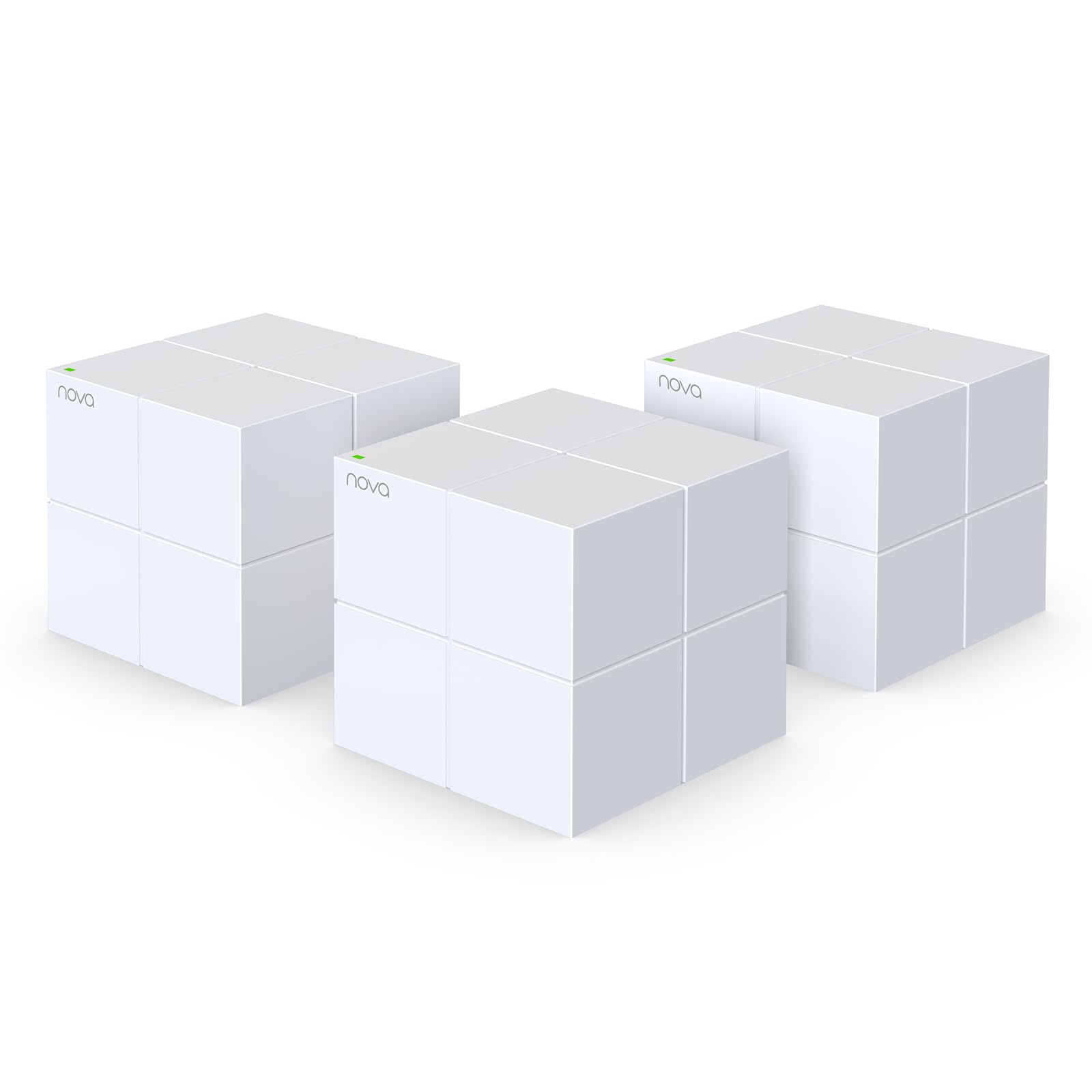
The Nova MW6 is the sensible mesh pick when you need the essentials done well, not a spec sheet that tries to audition for a performance tier. Its three-node system is built to cover up to 3,500 sq ft, so it solves dead zones across a real home instead of pretending one router can be brave in three rooms at once. AC1200 dual-band Wi‑Fi with MU-MIMO and beamforming is not the newest class of hardware, and that is exactly why it fits the budget tier: it focuses on stable coverage, easy roaming, and enough capacity for everyday streaming, work, and smart-home traffic. Up to 50 devices is plenty for a normal household, while Gigabit Ethernet on each unit gives you a clean wired path for a TV, console, or PC. The app setup is quick, the single SSID keeps movement painless, and WPA2-PSK plus guest access covers the basics without turning the network into a hobby.
Performance
⭐ 4.3

The Deco X20 is the practical middle ground for homes that have outgrown a basic router but do not need a lab-grade network. As a 3-pack Wi‑Fi 6 mesh system, it spreads coverage across up to 5,800 sq. ft. and keeps devices moving on one network instead of bouncing between separate names like a confused houseguest. Compared with a budget mesh kit, it brings stronger multi-device handling through OFDMA and MU-MIMO, plus support for up to 150 devices. That matters when phones, laptops, TVs, consoles, and smart gear all want attention at once. Compared with a high-end system, it stays focused on the essentials: solid whole-home coverage, seamless roaming, and 6 Gigabit Ethernet ports in total with Ethernet backhaul support. It is not tri-band, not Wi‑Fi 6E, and it does not pretend otherwise; that honesty is part of the appeal. You get stability, coverage, and wired flexibility in a system built to solve real home dead zones, not impress a spec sheet collector.
High-End
⭐ 4.2

The TP-Link Deco XE75 is the Wi-Fi 6E system you didn't know you were waiting for. It covers a staggering 7,200 sq. ft., which is roughly the size of your neighbor's envy. With the new 6 GHz band, your Wi-Fi won't just be fast; it'll be like lightning in a bottle. But, you know, without the bottle. AI-driven mesh means it learns from your browsing habits, which is simultaneously impressive and creepy. This three-pack replaces your old router and extenders, much like a bulldozer replaces a shovel. It's a tri-band speedster that won't flinch at connecting 200 devices, possibly more tech than friends in your life. It's the best in its price range because it does what others pretend to do without the drama.
Luxury
⭐ 4.3

This is the Luxury answer for homes that have outgrown a single router but do not need the absurdity of the Indecent class. The Deco BE65 combines Wi‑Fi 7 tri-band radios with 320 MHz channels, MLO, and 4K-QAM, so it is aimed at modern clients instead of politely pretending older mesh hardware can keep up. The three-pack and AI-driven mesh are built for broad indoor coverage under one network name, while the four 2.5G WAN/LAN ports let fast internet plans and wired devices breathe instead of being squeezed through yesterday’s plumbing. Compared with High-End mesh, the gain is not decorative: you get more serious wireless capacity, better backhaul options, and a setup that can handle a crowded smart home without turning the network into a committee meeting. Compared with Indecent systems, it stops short of the most extreme hardware class, but that is precisely why it makes sense here. You get premium coverage and modern Wi‑Fi 7 behavior without buying bragging rights your walls will never appreciate.
Indecent
⭐ 4.2
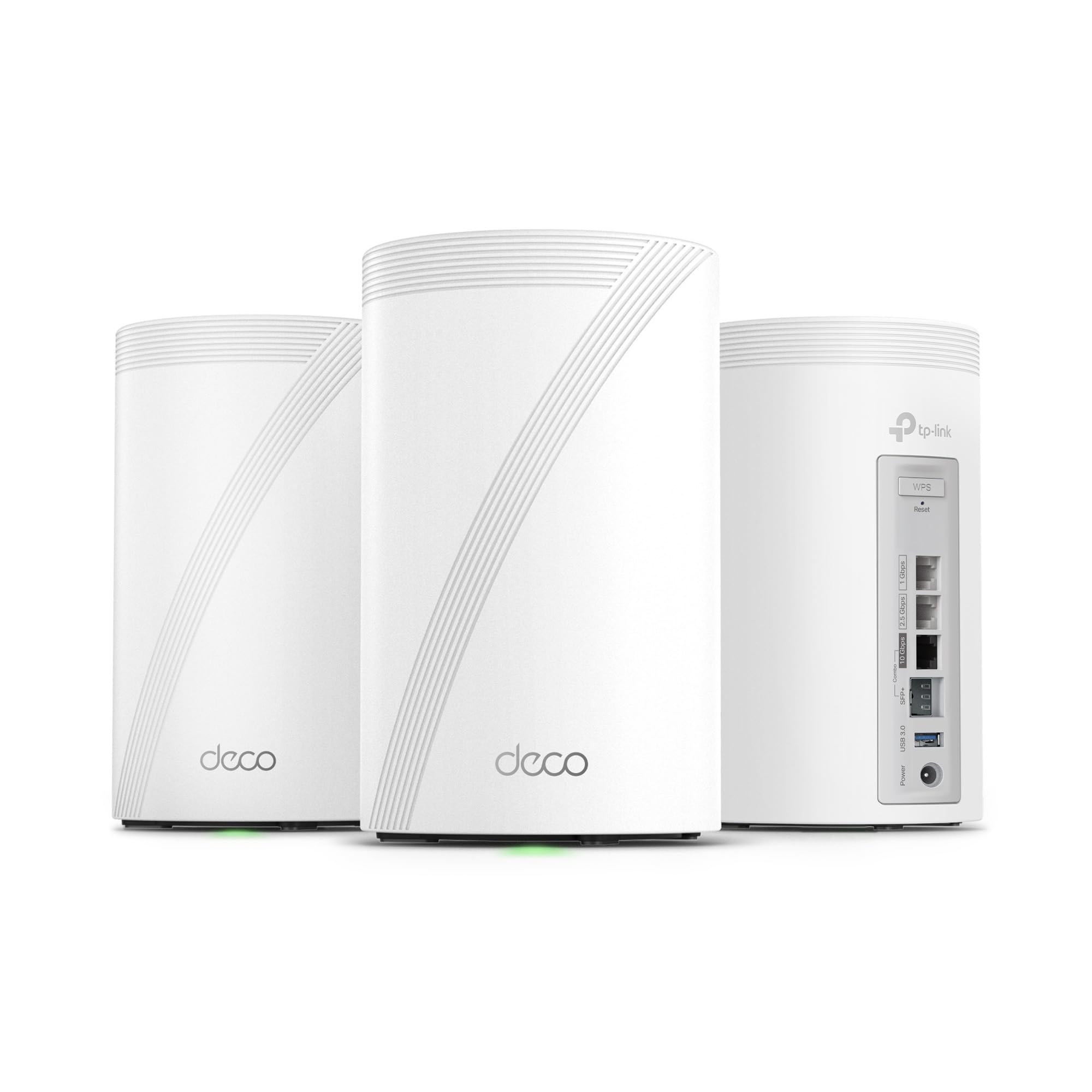
Le Deco BE77(3-Pack) vise les maisons où le Wi‑Fi doit cesser d’être un sujet de conversation. Avec du Wi‑Fi 7 tri-bande, 9 streams, MLO et une capacité annoncée jusqu’à 17 Gbps, il monte clairement au-dessus d’un mesh budget ou performance, qui s’arrête souvent dès qu’on lui demande de servir plusieurs étages, des TV 4K et une poignée d’objets connectés en même temps. Ici, chaque unité apporte un port combo 10 Gbps, un port 2.5 Gbps et un port 1 Gbps, plus un backhaul filaire 10 Gbps : ce n’est pas du décor, c’est ce qui évite que le réseau se mette à respirer fort au premier gros téléchargement. La couverture annoncée jusqu’à 8 500 sq ft et plus de 200 appareils le place dans une zone nettement plus ambitieuse qu’un simple haut de gamme; il prend la place du réseau domestique principal, pas celle d’un accessoire chic. On reste pourtant dans un produit grand public, pas dans une solution enterprise ou rackable. Bref, c’est le genre de mesh qui traite la maison comme une vraie infrastructure, sans demander à chaque pièce de faire semblant d’être proche de la box.
What changes from one range to the next
Budget starts with Tenda Nova MW6 AC1200 dual-band mesh for 3,500 sq. ft. and 50 devices, keeping setup simple. Performance moves to TP-Link Deco X20 with Wi‑Fi 6, AX1800 speeds, and six Ethernet ports for stronger wired flexibility. High-End adds Deco XE75’s Wi‑Fi 6E tri-band design, 6 GHz band, and AI-driven mesh. Indecent jumps to TP-Link BE77 on Wi‑Fi 7, with BE17000 tri-band performance, a 10G RJ45/SFP+ combo, MLO, AI-Roaming, and VPN support.